Metal Sheet and Bitumen Membrane Waterproofing in Chennai
Quick answer:
Metal sheet roofs in Chennai rarely leak through the sheet. They leak at screws, overlaps, ridge caps and gutters. We reseal those points and, on flat concrete roofs, bond a torch-applied APP bitumen membrane over the surface as a continuous waterproof sheet. Most work is done from the roof without stopping activity inside.
Book Your Expert Site Visit
Share your requirement and our waterproofing specialists will inspect the site and send you a tailored quotation.
Established 2016
A highly experienced applicator delivering superior quality compared to major brands.
Genuine Warranty
Warranty for Product + Service
promise to repair or replace a defective product or service at no extra cost.
Brands we used








Why sheet roofs struggle in Chennai?
Sheet roofing is everywhere in this city: factory sheds in Ambattur and Guindy, warehouses along the Sriperumbudur and Oragadam belt, and the roofing sheets many homeowners add over their terraces for shade. All of them face the same conditions.
Metal moves with heat. A long sheet can grow and shrink by several millimetres between a May afternoon and the following dawn. That movement, repeated daily, works screws loose and wears out the rubber washers under them. Coastal air then attacks any exposed edge or scratch, and rust starts along the overlaps. When the monsoon arrives with strong winds, rain is pushed sideways and upwards into laps that would stay dry in a gentle shower. Cyclone gusts can lift sheet edges enough to break old sealant altogether.

Roof waterproofing sheet: where APP bitumen membrane fits
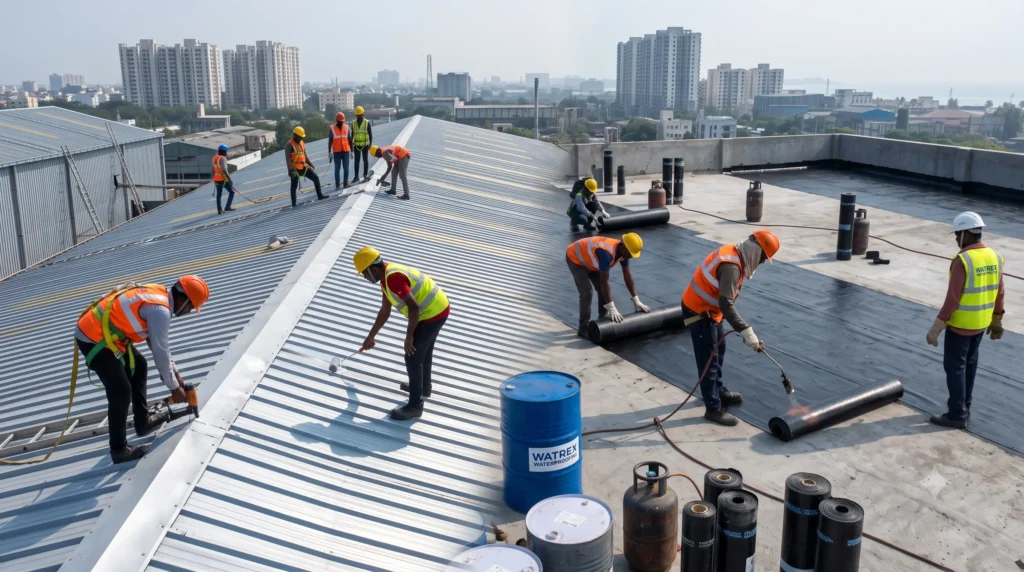
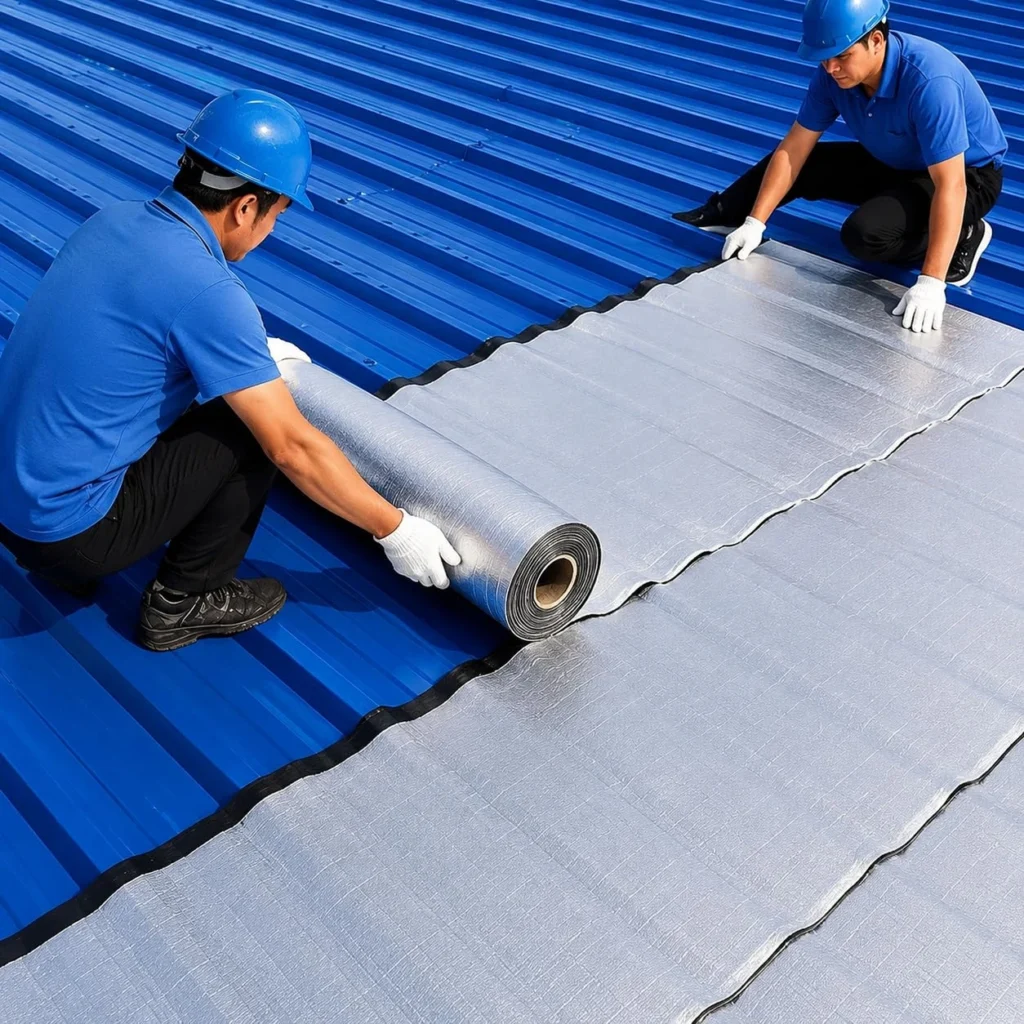
An APP membrane is a factory-made roof waterproofing sheet, 3 to 4 mm thick, supplied in rolls and bonded to the roof with a gas torch. Because it comes at a fixed thickness, the protection is even across the whole roof, which suits large flat terraces, podiums and industrial roof slabs. Rolls are overlapped by 100 mm and the laps are fused, so the finished roof behaves as one sheet. A mineral or aluminium-faced finish is used where the membrane stays exposed to the sun. On metal sheeting we do not use a torch; cold-applied tapes, sealants and coatings are used instead.
Signs your bathroom needs attention
- Drips directly below screw lines during rain
- Rust streaks along sheet overlaps or ridge caps
- Water overflowing or leaking at gutter joints
- Leaks around skylight sheets, turbo ventilators or exhaust ducts
- Daylight visible through fastener holes from inside
- Stains on stored goods, false ceilings or machinery below
What is actually going wrong
Fasteners have failed.
Each roof has thousands of screws, and each screw is a hole. Once the washer hardens and cracks in the sun, every one of them is a possible leak.
Overlaps have opened.
Side and end laps rely on a tight fit and a sealant strip. Thermal movement and wind loosen both, and capillary action draws water uphill into the gap.
Gutters and flashings were an afterthought.
Valley gutters, wall flashings and ridge caps are where sheets meet something else. These junctions are often sealed with ordinary silicone, which peels away within a couple of summers.
Rust has eaten the sheet.
Where corrosion has gone through, sealing alone will not hold. The damaged strip needs treatment and a bonded cover.
On flat concrete roofs, the bitumen membrane side of this service addresses a different fault: a large exposed slab with no reliable waterproof layer. There the membrane becomes the roof’s skin.
Recommended systems
| System | Where we use it | Typical life |
|---|---|---|
| APP-modified bitumen membrane, torch-applied, 3 to 4 mm | Flat concrete roofs, podiums, large terraces | 10 to 15 years |
| Self-adhesive aluminium-faced bitumen tape | Sheet overlaps, ridge caps, gutter joints | 7 to 10 years |
| PU sealant | Fastener heads, flashings, pipe and duct openings | 7 to 10 years |
| Rust converter and zinc-rich primer | Corroded sheet areas before any sealing | Part of the system |
| Elastomeric roof coating over full sheet | Old roofs with widespread minor leaks | 5 to 7 years |
Mineral-finished or aluminium-faced membranes are preferred for exposed roofs because they reflect heat and resist UV.
How we do the work
- Roof survey We walk the roof with safety lines, check from inside for daylight and stains, and map leak points on a drawing.
- CleaningDust, bird droppings, loose rust and failed sealant are removed by wire brushing and washing.
- Fastener service Loose screws are tightened or replaced with new washered screws, and every head is capped with PU sealant.
- Rust treatment
Corroded patches get rust converter and primer. - Lap and joint sealing Overlaps, ridge caps and flashings are sealed with aluminium-faced bitumen tape, pressed down with a roller.
- Gutterlining Gutters are cleaned and lined with membrane or liquid coating, with outlets cleared.
- Membrane or coating On concrete roofs, primer goes down first, then the APP membrane is torched on with 100 mm overlaps. On sheet roofs, a full elastomeric coat is applied where specified.
- Water test We hose-test the treated sections and check from below.
Most work is done without stopping operations inside the building. We schedule noisy or hot work around your shifts.
What decides your quote
For sheet roofs, the factors are roof area and height, safe access, the number of fasteners and laps to reseal, how far rust has gone, and gutter length. Large industrial roofs are measured and quoted item by item.
Frequently asked questions
Can the work be done while the factory is running?
Yes. Nearly all of it happens from the top of the roof. We agree a schedule with your team beforehand.
How long does bitumen membrane waterproofing last?
A torch-applied APP membrane on a well-prepared concrete roof typically serves ten years or more. Life depends on the membrane grade, the finish and how the roof is used. The warranty for your roof is stated in the quote.
Will torch-applied membrane damage my roof?
No. The flame softens the underside of the membrane, not the slab. On metal sheets we use cold-applied tapes and coatings instead.
How does it hold up in a cyclone?
Sealed laps and capped fasteners reduce wind-driven leaks sharply. We also flag loose sheets and weak purlin fixings during the survey so they can be secured.
Is there a warranty?
Yes, a written warranty is issued, with the term linked to the system used.
Can a leaking metal roof be repaired without replacing the sheets?
Usually yes. If the sheets are sound, we replace failed fasteners, seal the overlaps and treat the rust. Sheets are replaced only where rust has eaten through.
Do you waterproof asbestos and cement sheet roofs?
Yes. Laps and fixing points on cement sheets are sealed with the same tapes and sealants, with extra care because the sheets are brittle to walk on.
Do you do shed and warehouse roof waterproofing?
Yes. Factory sheds, warehouses and godowns are a large part of this work, and we schedule it around your shifts.
Book a roof survey - Call or WhatsApp WATREX with your roof size and location. We survey sheds, warehouses and homes across Chennai and send a written quote