
Terrace Waterproofing in Chennai
Quick answer:
Terrace waterproofing in Chennai means giving the roof slab one continuous, sealed layer that carries rainwater to the drain before it can soak into the concrete. Cracks, parapet joints and drain outlets are repaired first. A membrane suited to the slab is then applied and flood-tested for 48 hours against weather.
Book Your Expert Site Visit
Share your requirement and our waterproofing specialists will inspect the site and send you a tailored quotation.
Established 2016
A highly experienced applicator delivering superior quality compared to major brands.
Genuine Warranty
Warranty for Product + Service
promise to repair or replace a defective product or service at no extra cost.
Brands we used










Local conditions
Why terraces in Chennai fail early
A Chennai terrace takes a beating from two directions. From March to June the slab surface can cross 55°C by afternoon and cool sharply at night, so the top layer expands and shrinks every single day.
Then the northeast monsoon arrives and drops most of the year’s rain between October and December, often in a few heavy spells.
What is the best way to waterproof a terrace in Chennai?
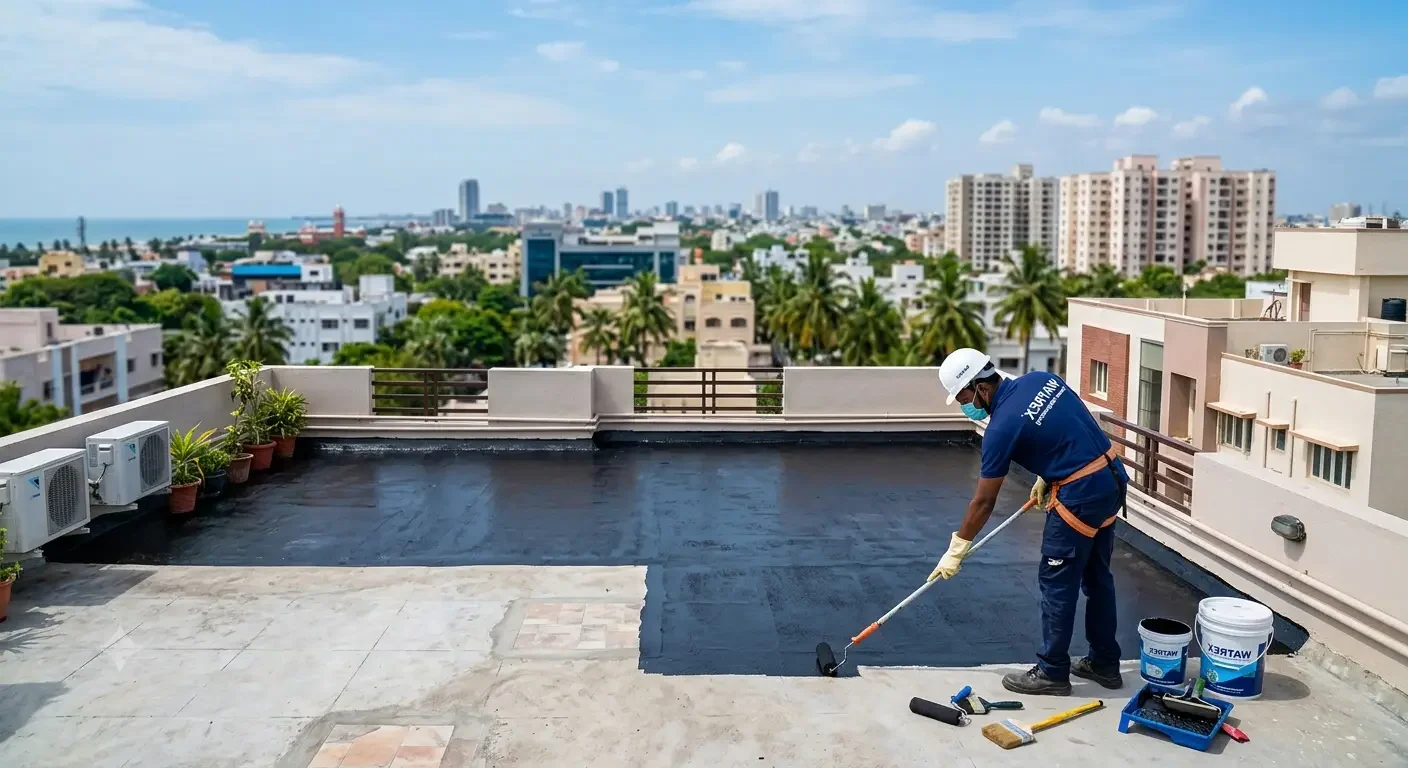
The Watrex terrace waterproofing starts with an inspection of cracks, parapet junctions, drain outlets and slope. The surface is then cleaned and repaired, critical details are reinforced, and a system suited to the slab, such as a polymer-based, acrylic, cementitious or membrane system, is applied in the specified number of coats.
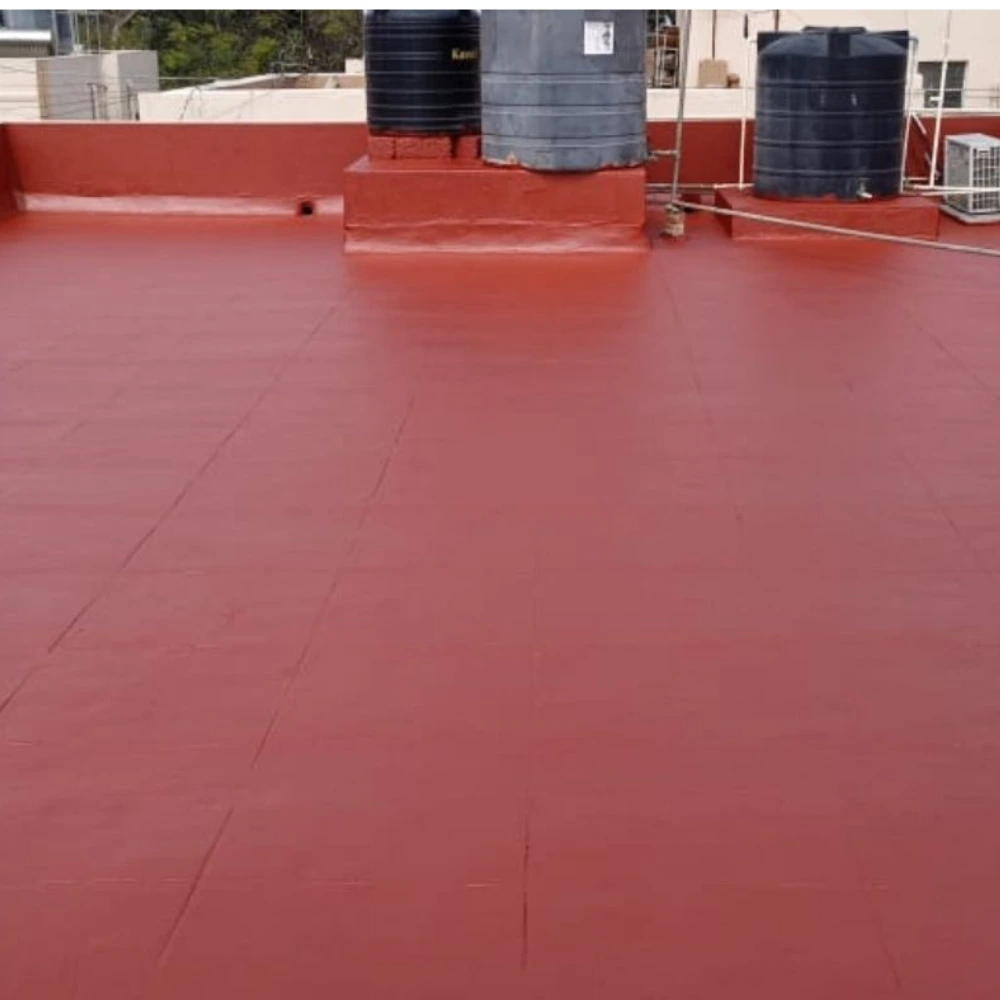
Old terrace waterproofing: tiled and weathering-course roofs
Most Chennai terraces are not bare concrete. They carry a brick-jelly weathering course, clay tiles, or cool-roof tiles laid years ago. When such a roof leaks, the question is whether the water is passing through the top layer or sitting trapped beneath it.
If the tiles are firmly bonded and the leak is limited to joints and parapet corners, we can treat the surface with a membrane rated for foot traffic and sunlight. If water is trapped under the weathering course, coating the top will not help, because the slab below stays wet. In that case the top layers come off, the slab is treated as a mother roof, and the finish is relaid. We check this with core cuts and moisture readings at the inspection, and you see the result before you decide.
Looking after a waterproofed terrace
A good membrane still needs a little care:
- Clear leaves and silt from drain outlets before the monsoon, so water does not pond.
- Do not drill into the terrace for dish antennas, solar frames or railings without sealing the fixings. Call us and we will detail them.
- Keep heavy planters on stands so the surface below can dry.
- Look at parapet corners and pipe entries once a year, and report any lifting or cracking early.
Check your property
Signs your terrace needs attention
Damp or yellow patches on the top-floor ceiling, usually a day or two after rain
Paint blistering or flaking near ceiling corners
Water standing on the terrace more than 24 hours
Cracked weathering tiles or open joints
Moss or small plants along the parapet wall
Rust stains or concrete chips falling from the ceiling
Root cause
What is actually going wrong
The slope is wrong
Water needs a fall of roughly 1 in 100 towards the outlet. When it ponds, it finds any weakness.
The joints were never detailed
The floor-to-parapet junction moves more than any other part of the roof and cracks open within a few summers.
The old treatment has aged
Once tile joints open, the weathering course holds water against the slab like a sponge.
A coat of waterproof paint over these faults buys one season at most. The repair has to deal with slope, joints and cracks first, and only then the membrane.
Recommended systems
System | Best for | Typical life |
|---|---|---|
PU liquid membrane | Exposed terraces, odd shapes, many pipe outlets | 10 to 15 years |
APP bitumen membrane, torch-applied | Large flat roofs, terraces that will be tiled over | 10 to 15 years |
Fibre-reinforced acrylic elastomeric coating | Sound terraces with minor cracks, tighter budgets | 5 to 7 years |
Heat-reflective top coat | Added over any system to cool the top floor | Recoat every 4 to 5 years |
We recommend a system after seeing the terrace, not before. A terrace that is walked on daily needs a different answer from one that will sit under tiles.
Our process
How we do the work
- Inspection and moisture mapping- We check slope, drains, cracks and the ceiling below, and mark every entry point.
- Surface preparation- Loose tiles, old coatings, dust and algae come off. Grinding or pressure washing gives the membrane a clean base.
- Crack and joint repair- Cracks are cut open in a V shape and filled with polymer mortar. A coving is formed along every parapet junction.
- Slope correction- Low spots are levelled with screed so water reaches the outlet.
- Primer- One coat seals the pores and bonds the membrane to the slab.
- Membrane application- Two or three coats, with reinforcing fabric at joints, corners and pipes, turned up the parapet by at least 300 mm.
- Pond test- If need We flood the terrace for 48 hours and check the ceiling below before handing over.( On added cost)
- Protection- A top coat, screed or tiles, depending on how the terrace will be used. ( For mother slap waterproofing)
What decides your quote
For terraces, the main factors are the roof area, whether tiles or weathering course must be removed, the number of drain outlets and pipe entries, and the membrane chosen.
Terrace Waterproofing FAQs
1
Can terrace waterproofing be done during the monsoon?
Yes, provided there is a dry window long enough for surface preparation and curing. Coatings require a dry surface and the specified curing time. During continuous rain, the inspection is completed first and the work is scheduled for the next suitable break.
2
Can you waterproof over existing tiles?
In some cases. It depends on whether the tiles are firmly bonded and whether water is already trapped beneath them. The inspection determines whether an over-tile system is suitable or the tiles must be removed.
3
How long does terrace waterproofing take?
It depends on the area, the repairs needed and the system. Surface preparation and crack repair come first, each coat needs its curing time, and the flood test adds 48 hours. We give you a day-by-day schedule with the written quote, so you know when the terrace will be out of use.
4
What is the best roof waterproofing method for a Chennai terrace?
There is no single best method. A PU liquid membrane suits terraces with many pipes and corners because it has no joints. A torch-applied APP bitumen membrane suits large, open roofs. A cementitious coating suits terraces that will be tiled over. We recommend one after seeing the slab.
5
Will waterproofing paint from a hardware shop fix my terrace leak?
It may hold for a season on a sound roof. It will not bridge moving cracks or seal parapet joints, and most leaks start at exactly those points.
6
Does terrace waterproofing reduce heat inside the house?
A white or reflective top coat lowers the surface temperature of the roof, which helps the rooms below. For proper cooling, the membrane is combined with cool-roof tiles or an insulating layer.
7
Do you provide terrace waterproofing near me?
We cover all of Chennai and its suburbs. Send us your area on WhatsApp and we will confirm a visit date.