
Swimming Pool Waterproofing in Chennai
Quick answer:
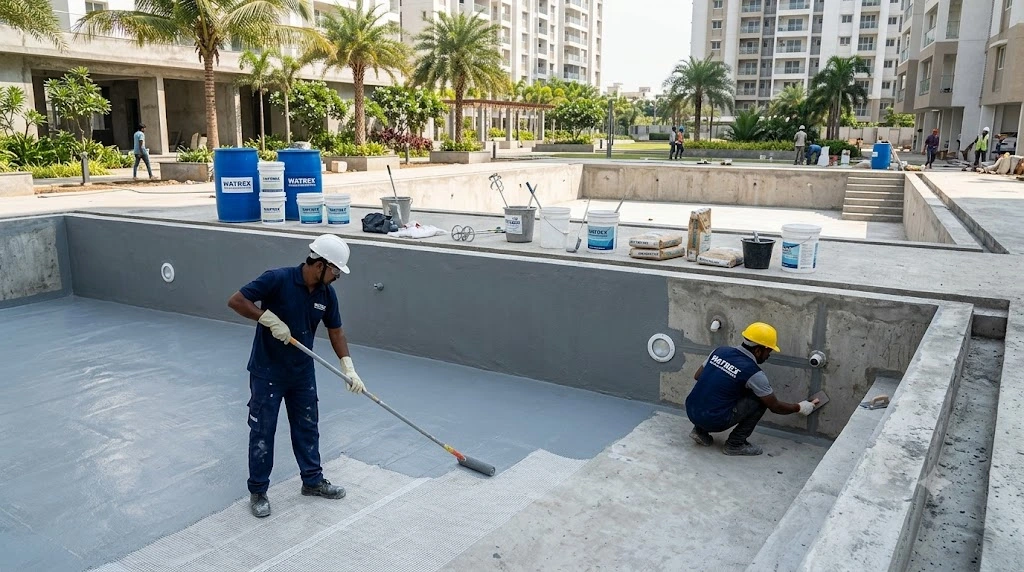
Swimming pool waterproofing lines the concrete shell under the tiles so the pool holds water under constant pressure. Leaks at pipes, lights, drains and joints are sealed first. The shell then receives a flexible membrane rated for permanent immersion and chlorinated water, and it is flood-tested for 72 hours before tiling.
Book Your Expert Site Visit
Share your requirement and our waterproofing specialists will inspect the site and send you a tailored quotation.
Established 2016
A highly experienced applicator delivering superior quality compared to major brands.
Genuine Warranty
Warranty for Product + Service
promise to repair or replace a defective product or service at no extra cost.
Brands we used










Local conditions
Why pools in Chennai need extra care
A pool is the hardest waterproofing job on any property. The structure holds tonnes of water every hour of every day, and the smallest gap will leak without pause.
Chennai adds its own difficulties. In low-lying and coastal areas such as Velachery, Pallikaranai and much of the ECR and OMR, the water table sits close to the surface and rises further in the monsoon. Ground water then pushes on the pool shell from outside. If the pool is emptied for cleaning at the wrong time, that outside pressure can crack the floor or lift tiles.
Rooftop and podium pools, now common in apartment projects, carry a different risk: any leak lands on the homes or car park directly below. And through the long summer, strong sun and pool chemicals together wear down ordinary tile grout faster than most owners expect.
Swimming pool leak detection
Before any repair, we confirm that the pool is leaking and where. The bucket test separates a leak from evaporation. A dye test at fittings, lights and cracks shows where water is being drawn out. A pressure test on the plumbing lines tells us whether the loss is in the shell or in the pipes. Only then do we quote.
Signs your pool is leaking
- Water level dropping more than about 5 to 7 mm a day in summer
- A need to top up far more often than before
- Tiles coming loose, cracking or sounding hollow
- Damp soil, sinking pavers or wet walls around the pool
- Stains or drips in the room or car park below a rooftop pool
- Higher chemical use to keep the water balanced
- Air bubbles in the return lines, or a pump that loses prime
A simple check: place a bucket of pool water on the steps and mark both levels. If the pool drops faster than the bucket over 24 hours, the loss is a leak and not evaporation.
Root cause
What is actually going wrong
Penetrations are leaking.
Inlets, the main drain, underwater lights and skimmers all pass through the shell. The joint between plastic fittings and concrete is the most common leak point in any pool.
Construction joints have opened.
The wall-to-floor joint, and any joint between separate concrete pours, will leak if a waterstop was not placed correctly during construction.
The membrane failed, or was never there.
Many pools are built with only waterproof plaster under the tiles. It cracks with the first small movement of the shell.
Tile grout has eroded.
Cement grout is porous. Once it wears, water sits permanently behind the tiles and works on the weak points above.
The shell has cracked.
Soil settlement or ground water pressure can cause structural cracks, which need injection before any coating.
A coat of waterproof paint over these faults buys one season at most. The repair has to deal with slope, joints and cracks first, and only then the membrane.
Recommended systems
| System | Where we use it | Typical life |
|---|---|---|
| Flexible two-component cementitious membrane | Full shell tanking under tiles | 10 to 15 years |
| Crystalline waterproofing | Shells facing ground water pressure from outside | Life of the concrete |
| PU injection grouting | Active leaks at pipe sleeves and joints | Permanent repair |
| Epoxy injection | Structural cracks in the shell | Permanent repair |
| Epoxy tile grout | All tile joints | 10 years or more |
| Polymer-modified tile adhesive | Bonding tiles to the membrane | Part of the system |
Every product used must be rated for permanent immersion and chlorinated water. Terrace-grade coatings do not survive in a pool.
Our process
How we do the work
- Leak detection.Bucket test, dye testing at fittings and pressure testing of pipelines to separate shell leaks from plumbing leaks.
- Drain down.The pool is emptied in stages, with ground water conditions checked first
- Strip. Loose or all tiles are removed, depending on the finding, and the shell is cleaned.
- Repair.Cracks are injected. Fittings are cut around, packed and sealed. A coving is formed at the wall-to-floor joint.
- Membrane.Primer, then two or three coats with mesh reinforcement at corners and around every penetration.
- Flood test.The pool is filled and the level monitored for 72 hours.
- Tiling. Tiles are fixed with polymer adhesive and joints filled with epoxy grout.
- Refill and balance.The pool is filled slowly and handed over.
What decides your quote
For pools, the factors are the shell area, how many tiles must be removed, the cracks and fittings to repair, the ground-water condition, and the membrane system.
Frequently asked questions
1
Can a leak be fixed without emptying the pool?
Small leaks at fittings can sometimes be sealed underwater as a temporary measure. A lasting repair needs the pool drained.
2
How do I know it is not just evaporation?
Use the bucket test described above. We repeat it as part of our inspection.
3
Do you waterproof rooftop and podium pools?
Yes. These need extra care at the joint between the pool and the building slab, because any leak goes straight into the floor below.
4
Do all the tiles have to come off?
Only if the membrane beneath has failed widely. For local leaks we open just the affected area.
5
Do you waterproof new pools during construction?
Yes, and it is the best time. The membrane is applied to the bare shell and tested before tiling, which costs far less than repairing a tiled pool later.
6
Is it safe to empty my pool during the monsoon?
Not always. Where ground water is high, we plan the drain-down carefully or wait for drier months.
7
Can you waterproof fountains and water features?
Yes. They are treated like small pools, with an immersion-grade membrane.
8
How soon can we swim again?
Usually within a week of refilling, once the water chemistry is balanced.
9
Is there a warranty?
Yes. A written warranty is provided after a successful flood test.