
Sidewall Waterproofing in Chennai
Quick answer:
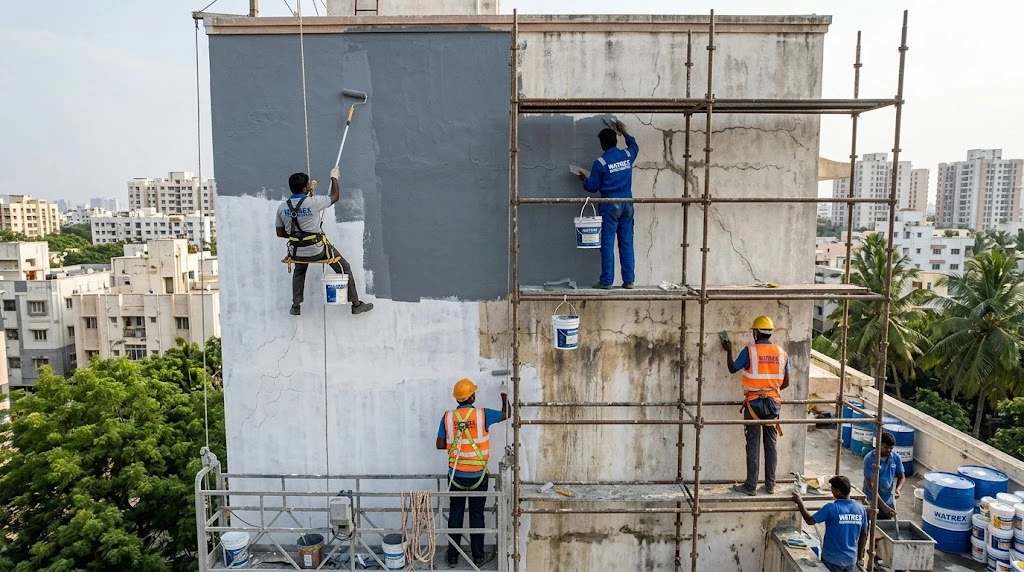
Sidewall waterproofing, also called exterior wall waterproofing, protects a building’s outer walls from wind-driven rain. Cracks, window joints and pipe openings are repaired first. The wall then receives a flexible, breathable coating that keeps rain out and lets trapped moisture escape. In Chennai, north and east-facing walls need it most.
Book Your Expert Site Visit
Share your requirement and our waterproofing specialists will inspect the site and send you a tailored quotation.
Established 2016
A highly experienced applicator delivering superior quality compared to major brands.
Genuine Warranty
Warranty for Product + Service
promise to repair or replace a defective product or service at no extra cost.
Brands we used










Local conditions
Why walls get wet in Chennai
During the northeast monsoon, rain rarely falls straight down. It comes in at an angle with the wind off the Bay of Bengal, and walls facing north and east take the worst of it for hours at a stretch. Ordinary cement plaster absorbs that water, and after two or three days of rain it reaches the inside face.
The second problem is specific to how the city is built. Houses and apartment blocks sit a few feet apart, sometimes less. The side walls in these narrow gaps never see direct sun, stay damp for weeks and are almost never repainted because nobody can reach them. Add humid sea air through most of the year, and those walls are the first place dampness shows up indoors.
Signs your walls need attention
- Damp patches on inner walls that grow during the rains
- White powdery salt deposits on paint or plaster
- Paint bubbling or peeling, especially below windows
- A musty smell in rooms along the outer wall
- Black or green algae streaks outside
- Visible cracks in exterior plaster, often at beam and column lines
- Wardrobes on outer walls developing mould at the back
Root cause
What is actually going wrong
Plaster cracks.
Brick walls and concrete frames expand at different rates in the heat. Cracks form along the lines where they meet, and each one lets rain straight into the brickwork.
Window and door frames leak.
The gap between frame and wall is commonly filled with plain mortar, which shrinks. Water runs in at the corners and shows up as a damp patch below the sill.
Service openings were left open.
Holes made for air-conditioner pipes, cables and plumbing are often patched roughly, or not at all.
The paint has given up.
Standard exterior emulsion chalks and thins in strong sun within a few years. Once it stops shedding water, the plaster behind it starts absorbing.
Ground moisture is rising.
On ground floors, dampness climbing from the foundation needs a different treatment at the base of the wall. We check for this so the right problem gets fixed.
Repainting the inside does nothing for any of these. The water has to be stopped on the outside face.
Exterior wall waterproofing systems we use
| System | Where we use it | Typical life |
|---|---|---|
| Polymer-modified crack filler and repair mortar | All plaster cracks before coating | Part of the system |
| PU sealant | Window and door perimeters, pipe openings | 7 to 10 years |
| Elastomeric acrylic exterior coating | Full wall face, bridges hairline cracks | 7 to 10 years |
| Clear silane-siloxane water repellent | Exposed brick, stone or textured finishes | 5 to 7 years |
| Polymer-modified waterproof plaster | Walls where old plaster has failed | 10 years or more |
Elastomeric coatings stretch with the wall, so new hairline cracks stay covered. They also let trapped moisture escape, which prevents blistering.
Our process
How we do the work
- Inspection.We trace each damp patch inside to its source outside, and check moisture levels with a meter.
- Access.Scaffolding where there is room. Rope access for tall buildings and narrow side gaps.
- Cleaning. Algae, loose paint and dust are removed by scraping and pressure washing, and the wall is left to dry.
- Crack repair. Cracks are cut open, filled with polymer mortar and reinforced with mesh where they are wide.
- Frame and opening sealing. Old mortar around frames is raked out and replaced with PU sealant. Pipe holes are packed and sealed.
- Primer. One coat to bind the surface.
- Waterproof coatingTwo coats of elastomeric membrane in the colour you choose.
- Hose test. Treated walls are sprayed and the inside checked.
A typical independent house takes six to ten days, depending on height and access.
What decides your quote
For walls, the factors are the wall area, the building height and the access it needs, the extent of crack repair or replastering, and the coating system.
Frequently asked questions
1
Can you treat the wall from inside instead?
Inside treatment hides the symptom for a while. The lasting fix is on the outside, where the water enters. Where outside access is truly impossible, we explain the interior options and their limits.
2
What is the best wall water leakage solution?
Stop the water on the outside face. Repair the cracks, seal around windows and pipes, and coat the wall with an elastomeric membrane. Putty or damp-proof paint on the inside hides the stain while the wall stays wet.
3
Do you treat parapet walls?
Yes. Parapet tops and the joint where the parapet meets the terrace are common entry points, and we treat them with the wall or the terrace.
4
Why does my wall get damp only on one side of the house?
That side faces the monsoon wind. In Chennai the northeast monsoon drives rain against north and east walls, so those walls soak while the others stay dry.
5
My side wall has only a two-foot gap. Can you reach it?
In most cases, yes. Our rope access team works in narrow gaps where scaffolding cannot be erected.
6
Do I need to repaint afterwards?
No. The elastomeric coating is the finish coat and comes in a range of colours.
7
When should the work be done?
Between January and September, when walls are dry. Coatings do not bond well to a wet wall.
8
How long before the inside dries out?
Inner walls usually take four to eight weeks to dry fully after the outside is sealed. Repaint inside only after that.
9
Is there a warranty?
Yes, a written warranty is issued with every job.