
Epoxy Injection Grouting in Chennai
Quick answer:
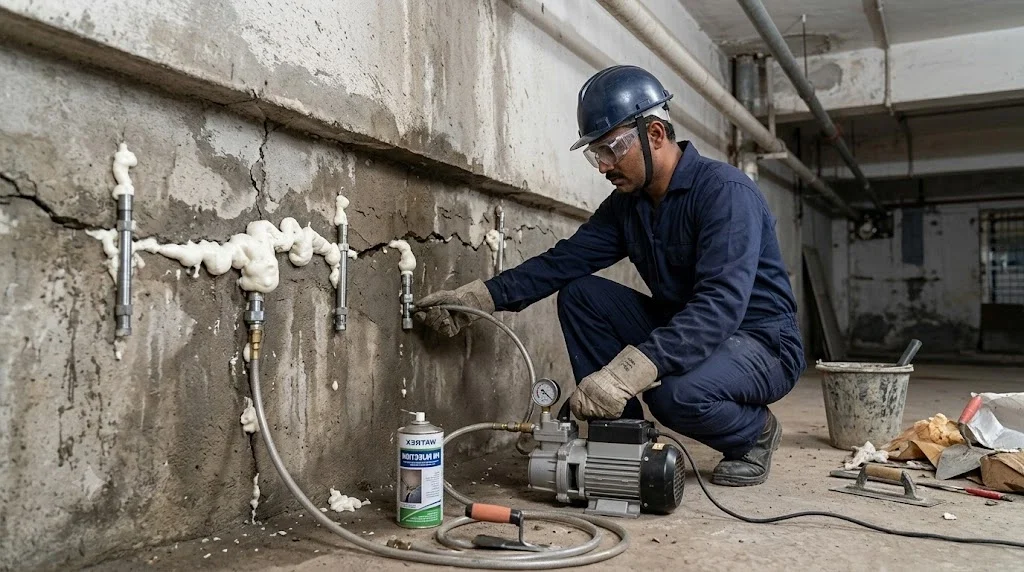
Epoxy injection grouting repairs structural cracks in concrete beams, columns, slabs and walls. A low-viscosity epoxy resin is injected under pressure until it fills the full depth of the crack. Once it cures, it bonds the two faces together and restores the member’s strength. It is used on dry cracks; leaking cracks are sealed with PU first.
Book Your Expert Site Visit
Share your requirement and our waterproofing specialists will inspect the site and send you a tailored quotation.
Established 2016
A highly experienced applicator delivering superior quality compared to major brands.
Genuine Warranty
Warranty for Product + Service
promise to repair or replace a defective product or service at no extra cost.
Brands we used







Local conditions
Why structural cracks are common in Chennai
Chennai is hard on reinforced concrete. Humid, salt-laden air from the coast carries chlorides into the concrete surface, more so in areas near the sea such as Besant Nagar, Thiruvanmiyur, Royapuram and the ECR. Once those chlorides reach the steel, it rusts. Rust takes up more space than steel, so it pushes outwards and splits the concrete along the line of the bar.
A large share of the city’s apartment stock is now 20 to 40 years old, built when concrete cover and mix quality were less tightly controlled. Add repeated flooding in low-lying areas, daily thermal movement and the extra floors many owners have added over the years, and cracks in beams, columns and slabs are a regular finding during building inspections.
A crack is more than a cosmetic flaw. It is an open path for moisture and air to reach the steel, which speeds up the damage. Sealing it early is far cheaper than rebuilding the member later.
Signs you need epoxy injection
- Cracks in beams, columns, slabs or shear walls
- Cracks that run along the length of a beam or column, following the steel
- Diagonal cracks near beam ends or at column heads
- Cracks that have grown longer or wider over months
- Cracks you can see on both faces of a wall
- Cracks that appeared after nearby piling, excavation or flooding
- A hollow sound when the concrete around a crack is tapped
If a crack is wider than a few millimetres, or a member has visibly sagged, have a structural engineer examine it before any repair.
Root cause
What is actually going wrong
Corrosion of reinforcement.
The most frequent cause in coastal Chennai. Cracks run parallel to the bars, often with rust stains.
Overloading.
Added floors, heavy water tanks or a change of use put more load on members than they were designed for.
.
Shrinkage and thermal movement.
These cause fine cracks that are stable but still admit moisture.
Poor construction.
Low cover, honeycombing and early removal of formwork leave weak zones that crack under normal use.
.
Settlement.
Uneven movement of foundations, sometimes after flooding or adjacent construction, produces diagonal cracking.
Epoxy injection repairs the crack. It does not remove the cause. If steel is rusting or the member is overloaded, that has to be addressed as well, or the crack will return beside the repair. Our inspection report states which applies.
Recommended systems
| System | Where we use it | Notes |
|---|---|---|
| Low-viscosity two-component epoxy injection resin | Cracks from about 0.2 mm upwards | Flows into fine cracks and cures stronger than concrete |
| Epoxy putty or paste | Sealing the crack face before injection | Holds the resin in under pressure |
| Surface-mounted injection ports | Fine cracks, thin members | Fixed over the crack without drilling |
| Drilled packers | Wide or deep cracks, thick members | For higher injection pressure |
| Rust converter and anti-corrosion primer | Exposed or rusting steel | Applied before patch repair |
| Polymer-modified repair mortar | Rebuilding spalled concrete | Restores cover over the steel |
Our process
How we do the work
- Assess. We measure crack width and length, tap-test the surrounding concrete and check for corrosion. Where needed, we work to a structural engineer’s recommendation.
- Clean.The crack line is wire-brushed and blown out with compressed air.
- Fix ports.Injection ports are fixed along the crack at intervals roughly equal to the thickness of the member.
- Seal the surface.The crack between the ports is sealed with epoxy putty and left to harden.
- Inject.Resin is injected at low, steady pressure, starting from the lowest port. When resin appears at the next port, the first is closed and injection moves up.
- Cure.The resin is left to cure, normally 24 hours.
- Finish.Ports are removed and the surface ground flush, ready for plaster or paint.
- Report.You receive a record of the cracks treated and the material used.
Most residential repairs are completed in one to three days, with no need to vacate the building.
Frequently asked questions
1
Is epoxy injection a permanent repair?
Yes, for cracks that have stopped moving. The cured resin is stronger than the concrete it bonds.
2
Can it be used to stop a water leak?
No. Epoxy does not bond well in wet cracks. PU injection is the right method for active leaks.
3
How fine a crack can be injected?
Cracks from about 0.2 mm wide can be filled with low-viscosity resin.
4
My building is near the beach. Will the cracks come back?
If corrosion is the cause, the steel must be treated and the surface protected with an anti-carbonation coating. Otherwise new cracks are likely.
5
Do we need a structural engineer?
For fine, stable cracks, usually not. For wide cracks or main load-bearing members, yes, and we can arrange one.
6
Is there a warranty?
Yes, a written warranty covers the injected cracks.
Get your cracks assessed - Send clear photos on WhatsApp or call WATREX. We inspect homes, apartments and commercial buildings across Chennai.