
Local conditions
Why bathroom leak so often in your home?
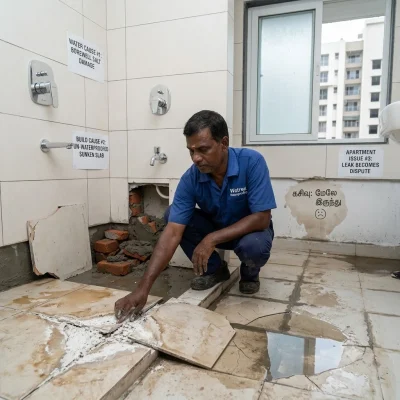
A bathroom floor is wet several times a day, all year, so even a small defect shows up quickly. Three major factors make things worse.
First, the water. Many homes in the city run on borewell or tanker water with high salt content. Those salts eat into cement grout and leave it powdery within a few years.
Second, the way bathrooms are built. Most have a sunken slab filled with brick bats and mortar to hide the pipes. If the sunken portion was not waterproofed, that filling becomes a hidden reservoir that feeds a leak for months.
Third, apartment living. In a flat, your bathroom floor is your neighbour’s ceiling. A leak quickly becomes a dispute with the people downstairs and the association.
Signs your bathroom needs attention
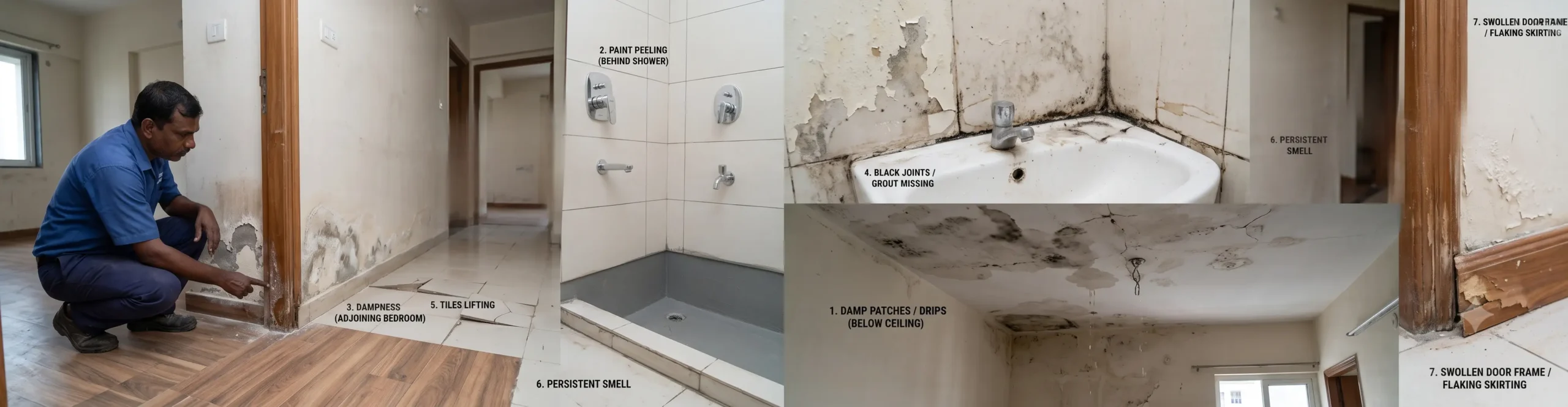
- Damp patches or drips on the ceiling of the room or flat below
- Paint peeling on the wall behind the shower or wash basin
- Dampness at the bottom of walls in the adjoining bedroom
- Tile joints turning black, or grout missing
- Tiles lifting or sounding hollow
- A persistent damp smell even after cleaning
- Swollen door frames and flaking skirting
What is actually going wrong
Tile joints have failed.
Tiles do not leak, but the joints between them do. Once grout erodes, every bucket of water sends a little below.
The floor trap and pipe joints are unsealed.
The gap around the floor drain, the WC outlet and pipe entries is the most common entry point. It is often packed with plain cement.
There is no membrane, or it stops short.
Waterproofing must cover the floor and run up the walls, to full height in the shower area. Many bathrooms have it only on the floor, or not at all.
Concealed pipes are leaking.
A weeping joint inside the wall produces the same damp patch as a failed floor. We pressure-test the lines to tell the two apart, because coating the floor will not fix a pipe.
The sunken fill is saturated.
Where water has collected in the fill, it needs a drainage outlet or removal. Sealing the top alone traps it.
Recommended systems
System | Where we use it | Typical life |
|---|---|---|
Epoxy tile joint grout | No-breakage repair, all new tiling | 10 years or more |
Clear penetrating sealer | No-breakage treatment over existing tiles | 3 to 5 years |
Polymer-modified cementitious membrane, two coats | Sunken slab, floor and walls under tiles | 10 years or more |
PU or epoxy membrane | High-use bathrooms, bathrooms above living spaces | 15 years or more |
Sealant collars and non-shrink grout | Around floor traps and pipes | Part of the system |
Two ways to fix it
- Without breaking tiles.
Suitable when tiles are firmly bonded and the leak comes through joints or around the trap. We rake out the old grout, fill with epoxy grout, seal around every fitting and apply a clear sealer. Work is finished in one to two days.
With tile removal. Needed when tiles are hollow, the fill is saturated or earlier quick fixes have failed. This is a full rebuild of the waterproof layer and takes five to seven days. We tell you plainly which one your bathroom needs after inspection.
Our process
How we do a full treatment
- Diagnose.Moisture readings, pipe pressure test and inspection of the ceiling below
- .Strip.Tiles and, where required, the sunken fill are removed.
- Prepare the slab.Cracks are repaired, pipe entries packed with non-shrink grout and a coving formed at wall-floor junctions.
- First membrane.Two coats on the sunken slab and up the walls.
- Pond test.Water is held for 24 to 48 hours and the ceiling below checked.
- Refill and screed.Pipes are laid, the sunken portion refilled and a sloped screed laid towards the drain.
- Second membraneA further coating over the screed, to full height in the shower area.
- Tile and grout.Tiles are laid with polymer adhesive and finished with epoxy grout.
Cost in Chennai
Work | Indicative rate |
|---|---|
No-breakage treatment | ₹2,500 to ₹8,000 per bathroom |
Cementitious membrane system | ₹40 to ₹70 per sq ft |
PU or epoxy membrane under tiles | ₹80 to ₹120 per sq ft |
Tile removal, new tiles and plumbing changes are quoted separately. A typical bathroom has 100 to 150 sq ft of floor and wall area to treat.
Frequently asked questions
1
Can it really be fixed without breaking tiles?
In many cases, yes. If the tiles are sound and the leak is through joints or fittings, epoxy grouting works well. If water is coming through the slab from a saturated fill, it will not be enough, and we will tell you so.
2
How long is the bathroom out of use?
One to two days for no-breakage work. Five to seven days for a full treatment.
3
The leak is from my upstairs neighbour's bathroom. What can I do?
The repair has to happen in the bathroom above. We can inspect both flats and give a report that helps the two owners agree on the work.
4
Should I waterproof a new bathroom?
Always. It costs little during construction and avoids breaking finished tiles later.
5
Is there a warranty?
Yes, a written warranty is given, with the term depending on the method used.