Water Tank Waterproofing in Chennai
Quick answer:
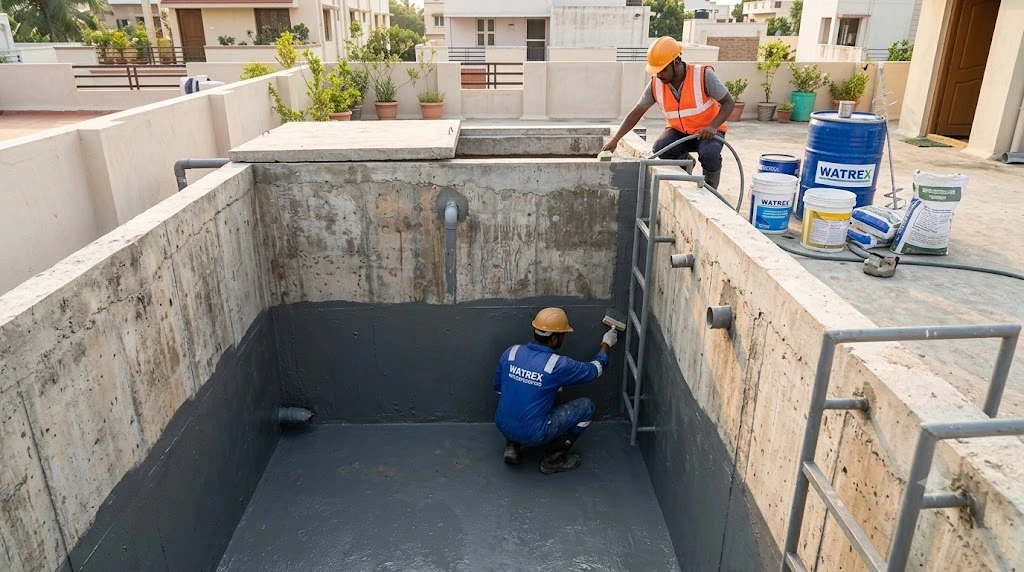
Water tank waterproofing seals the inside of a concrete or masonry tank with a coating that is certified safe for drinking water. Leaking joints, cracks and pipe entries are repaired first. The floor and walls are then coated in two layers, cured, disinfected and refilled, and the level is watched for 48 hours.
Book Your Expert Site Visit
Share your requirement and our waterproofing specialists will inspect the site and send you a tailored quotation.
Established 2016
A highly experienced applicator delivering superior quality compared to major brands.
Genuine Warranty
Warranty for Product + Service
promise to repair or replace a defective product or service at no extra cost.
Brands we used










Why overhead and RCC water tanks leak in Chennai
Nearly every building in the city stores its water in an overhead tank, and that tank sits in the harshest spot on the property: the roof.
The outside of the tank bakes in direct sun while the inside stays cool and wet. That difference in temperature between the two faces of the same wall causes fine cracks over time. Water quality adds to it. Borewell and tanker water in many areas is high in dissolved salts, and treated supply carries chlorine. Both slowly attack plain cement plaster inside the tank.
Then there is the load. A 10,000 litre tank holds ten tonnes of water. That pressure sits on the wall-floor joint without a break, and a leak there falls straight onto the slab below, often above a bedroom.

Signs your tank needs attention
- Wet patches or algae on the outside walls of the tank
- White salt lines on the outer surface
- Dampness or dripping on the ceiling directly below
- Water level falling when no tap is in use
- The motor running more often than it used to
- Flaking plaster or exposed steel inside the tank
- Cracks around the inlet, outlet or overflow pipes
What is actually going wrong
The wall-floor joint is leaking.
This joint carries the highest water pressure and is usually a cold joint from construction. It is the first place to check.
Pipe entries were never sealed.
Inlet, outlet, overflow and scour pipes pass through the wall. The mortar packed around them shrinks and leaves a ring-shaped gap.
The plaster is porous.
Waterproof plaster is only as good as the workmanship on the day. Thin or badly cured patches seep.
The tank base is leaking onto the roof.
Where the tank sits directly on the terrace slab, a leaking base saturates the roof under it, and the complaint is often mistaken for a terrace leak.
Steel has started to rust.
Once moisture and salts reach the reinforcement, rust swells and pushes the cover concrete off. At that stage the tank needs structural repair before coating.
Thermal cracks have formed.
Daily heating and cooling open vertical cracks, typically at the corners.
Recommended systems
| System | Best for | Typical life |
|---|---|---|
| Crystalline cementitious coating | Concrete tanks, seals pores from within | Life of the concrete |
| Food-grade epoxy coating | Smooth, easy-to-clean finish for drinking water | 8 to 10 years |
| Polymer-modified cementitious coating, potable grade | Masonry and plastered tanks | 7 to 10 years |
| Non-shrink grout and sealant | Pipe entries and wall-floor joints | Part of the system |
| Injection grouting | Leaking cracks and cold joints | Permanent repair |
| Exterior elastomeric coating | Outer walls and tank cover, cuts heat stress | 5 to 7 years |
Only coatings certified for contact with drinking water go inside a tank. We share the product data sheet before work begins.
How we do the work
- Inspection.We check the tank inside and out and the slab below.
- Empty and clean.The tank is drained, sludge removed and the surface washed down.
- Ventilate. Fresh air is provided before anyone works inside the tank.
- Repair. Loose plaster is removed. Cracks are opened and filled. Rusted steel is treated.
- Seal the joints.Pipe entries are repacked with non-shrink grout. A coving is formed along the wall-floor joint.
- Grout where needed.Leaking cold joints are injected.
- Coat.Two coats on floor and walls, the second at right angles to the first.
- Cure.The coating is cured as the product requires, usually five to seven days
- Rinse and refill.The tank is washed, disinfected, filled and checked for 48 hours.
What decides your quote
For tanks, the factors are the tank’s capacity and inner surface area, the condition of the plaster and steel, the number of leaking joints and pipe entries, and the coating chosen.
Frequently asked questions
Is the coating safe for drinking water?
Yes. We use only coatings rated for potable water, and the tank is rinsed and disinfected before refilling.
How long will we be without the tank?
About a week, mostly curing time. Rushing the cure is the main reason tank coatings fail.
What is the procedure for overhead water tank waterproofing?
Drain and clean the tank, repair cracks and pipe entries, form a rounded cove at the wall-floor joint, apply two coats of a potable-grade coating, cure it, then disinfect and refill.
My ceiling is damp under the tank. Is it the tank or the terrace?
Often it is the tank base. A tank resting on the slab can leak straight into the roof below and look like a terrace leak. We test the tank first, so you do not pay for terrace work you do not need.
Can you fix it from outside without emptying the tank?
Outside patching rarely holds because water pressure pushes it off. The repair must be done on the inside face.
Do you treat plastic tanks?
No. Cracked plastic tanks are better replaced. Our work covers RCC and masonry tanks.
Do you waterproof apartment and commercial overhead tanks?
Yes. For larger tanks, we work one compartment at a time where possible, so the building keeps its water supply.
How often should a tank be re-coated?
Inspect it during the yearly cleaning. A good system lasts eight to ten years or longer.
Is there a warranty?
Yes, a written warranty is issued after the fill test.