
Mother Roof Waterproofing in Chennai
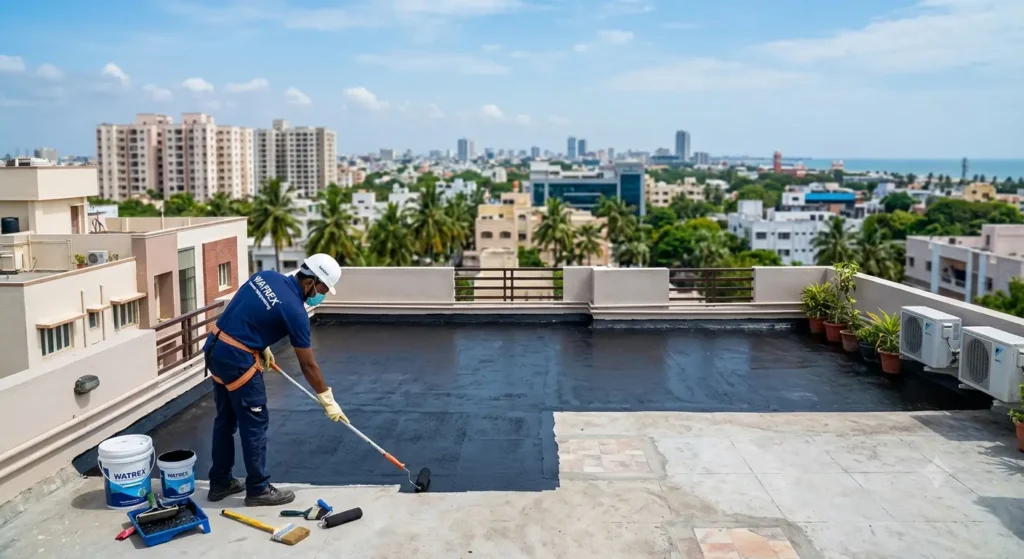
Quick answerMother roof waterproofing means treating the bare structural concrete slab itself, before any screed, weathering course or tile is laid on top. It is the most dependable stage to waterproof a roof because the membrane bonds directly to the concrete. In Chennai it typically costs ₹40 to ₹180 per sq ft, depending on the system.
Local conditions
Why the slab stage matters in Chennai
In most Chennai homes the roof is built in layers: the RCC slab, then a brick jelly lime weathering course, then pressed clay tiles. The upper layers keep the house cool, which matters in a city where summer afternoons reach 40°C. They do not keep water out.
If the slab below is left untreated, water that gets past the tiles sits inside the weathering course for weeks after the monsoon. It then travels sideways along the slab until it finds a weak point, which is why the damp patch on your ceiling is often metres away from the crack on the terrace. Treating the mother slab stops water at the last line of defence, wherever it entered above.
For new construction, the right moment is after the slab has cured and before the weathering course is laid. For older buildings with repeated leaks, it means removing the top layers and starting from the concrete.
Signs you need mother roof treatment
- Leaks that return every monsoon despite surface coatings
- Damp lines following beams or the slab edges
- Rust stains or exposed steel on the ceiling
- A weathering course that stays wet long after rain
- Ceiling plaster that sounds hollow or falls away
- A new slab about to receive its top layers
Root cause
What is actually going wrong
The concrete is porous in places.
Slabs poured in peak heat lose water quickly, and poor vibration leaves honeycombs. These are invisible from above once plastered over.
Water is trapped above the slab.
A saturated weathering course keeps the slab wet for months, giving moisture time to reach the reinforcement. Near the coast, chlorides make the steel rust faster, and rusting steel swells and cracks the concrete from within.
Construction joints were not treated.
Where one day’s pour met the next, there is a cold joint. Water follows it like a pipe.
The old treatment has ageCuring was cut short.
A slab cured for a week instead of the recommended period develops shrinkage cracks across its surface.
Surface coatings on the tiles cannot solve any of these. The slab has to be exposed, repaired and sealed.
Recommended systems
System | Best for | Typical life |
|---|---|---|
Two-component polymer-modified cementitious coating | New slabs to be covered by weathering course | 8 to 10 years |
PU liquid membrane | Slabs with movement cracks, long-term protection | 10 to 15 years |
Crystalline waterproofing slurry | Porous concrete, construction joints | Life of the concrete |
Cementitious pressure grouting | Honeycombs and cold joints, before coating | Permanent repair |
Protective screed, 25 to 40 mm | Over every membrane before top layers | Part of the system |
On many roofs we combine two: grouting or crystalline treatment for the weak zones, then a full membrane over the whole slab.
Our process
How we do the work
- Expose and inspect.On existing roofs, tiles and weathering course are removed. On new slabs, we check that curing is complete.
- Clean the slab. Laitance, dust and loose mortar are ground or wire-brushed away.
- Repair defects. Honeycombs are cut back and filled with polymer mortar. Cracks are opened and sealed. Exposed steel is cleaned and coated with rust inhibitor.
- Grout the joints.Construction joints and porous patches are pressure-grouted.
- Form the coving. A rounded fillet is built along every parapet and pipe junction.
- Apply the membrane. Primer, then two coats applied at right angles, carried 300 mm up the parapet.
- Pond test.The slab is flooded for 48 to 72 hours and the ceiling checked.
- Protect.A screed is laid to protect the membrane, after which the weathering course or tiles can go on.
A typical 1,000 sq ft slab takes seven to ten working days including the pond test.
Cost in Chennai
System | Indicative rate per sq ft |
|---|---|
Polymer-modified cementitious coating | ₹40 to ₹70 |
PU liquid membrane | ₹120 to ₹180 |
Pressure grouting of joints | From about ₹75, by area treated |
Removing and relaying the weathering course and tiles is quoted separately. New-construction slabs cost less because there is nothing to remove.
Frequently asked questions
1
What does mother roof mean?
It is the term used locally for the bare structural RCC roof slab, before any finishing layers are added.
2
My building is ten years old. Is it too late?
No. We remove the top layers, treat the slab and rebuild them. It costs more than doing it at construction, but it ends recurring leaks.
3
Can I skip this and just coat the tiles?
A surface coat helps for a season or two. If water has already reached the slab, only slab-level treatment stops it.
4
How soon after casting can a new slab be treated?
After curing is complete and the surface is dry, usually around four weeks from casting.
5
Will the house get hotter without the weathering course?
The weathering course or an insulating screed goes back on after waterproofing, so you keep the cooling benefit.
6
Is there a warranty?
Yes. A written warranty is provided, and its term depends on the system.